The Wealthy Collector Was About to Spend Two Million Dollars on the “Last Original Painting”—Then the Cleaning Lady Looked at the Frame and Said, “Please Don’t Buy It”133

**Title: **
The gallery was filled with the city’s elite. Men in tailored suits and women in designer gowns sipped champagne and spoke in hushed, reverent tones. The walls were lined with paintings—abstract pieces, landscapes, portraits—all of them framed in gold, all of them illuminated by soft, carefully positioned lights. This was the opening night of the most anticipated exhibition of the year. And at the center of it all was a single painting.
It was called *The Last Original*. It was attributed to a recently discovered artist—a recluse who had supposedly died penniless, leaving behind a cache of unknown masterpieces. The painting was expected to fetch two million dollars at auction. The collector, Victor Hayes, was already reaching for his checkbook.
But then he stepped back.
He stepped back too quickly, too carelessly, and knocked over the cleaning cart that had been parked near the wall. Bottles of cleaner clattered to the floor. A mop fell. A bucket tipped. Soapy water spread across the polished concrete.
Victor turned. His face was red. His voice was sharp.
“Don’t touch anything that costs more than your salary.”
The cleaning lady—Grace—knelt down. She began gathering the bottles. Her hands were rough. Her uniform was faded. She was in her late fifties, with grey hair and tired eyes and the kind of face that had learned to be invisible.
And then she looked up at the painting.
“Please don’t buy it,” she said.
The gallery went silent. Then someone laughed. Then someone else. Soon, the entire room was laughing.
“Now the cleaning lady is an art critic,” someone said.
The art dealer—Julian—stepped forward. He was a sleek man with a practiced smile and expensive shoes. He gestured to the security guard.
“Escort her out.”
Grace did not move. She simply looked at the painting.
“Look under the frame,” she said. “The bottom left corner.”
Julian frowned. “What?”
“Just look.”
—
**The Blue Bird**
Julian hesitated. Then he walked to the painting. He tilted the gold frame forward. He looked at the bottom left corner.
And there, hidden beneath the edge of the frame, was a tiny blue bird.
It was small—barely the size of a thumbnail. It was painted in a shade of blue that seemed almost alive. And the paint was fresh.
Julian’s tablet slipped from his hand. It clattered to the floor.
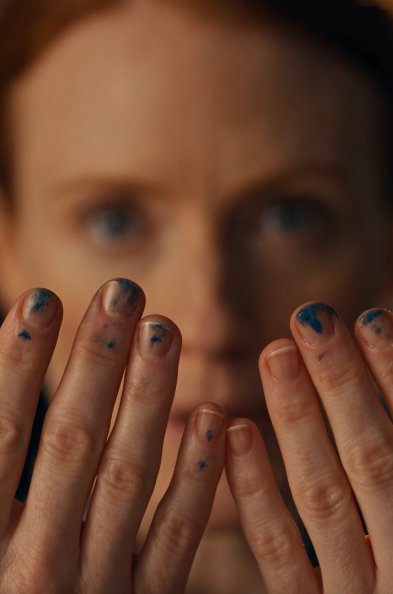
Grace held up her fingers. There were still traces of blue paint on her skin.
“I painted that bird on every reproduction I made,” she said.
The room went silent again—but this time, the silence was different. It was not amused. It was not mocking. It was confused.
“What do you mean, reproduction?” Victor asked.
Grace stood up. She looked at Julian.
“He paid me two hundred dollars for this painting.”
—
**The Story**
Two years ago, Julian had hired Grace to paint “reproductions for hotel decoration.” She had been a struggling artist—talented, trained, but unable to make ends meet. She had student loans she could not pay. She had rent she could not afford. She had taken the job because she had no other choice.
Julian had told her the paintings were for hotels. He had told her they were decorative pieces. He had told her they would be sold for a few hundred dollars each.
He had lied.
Grace had always painted a small blue bird on her reproductions. It was a habit from her student days—a signature that would not be noticed, a mark that would prove the work was hers. She had never expected anyone to look for it. She had never expected anyone to care.
But then she had seen one of her paintings on the news. It had been sold at auction for eight hundred thousand dollars. It had been labeled as the work of a recently discovered master.
She had gone to Julian’s gallery. She had applied for a job as a cleaner. She had spent months photographing every painting that came into the warehouse. She had waited until she had enough evidence.
And tonight, she had finally spoken.
—
**The Confession**
Julian’s face was pale. His hands were shaking.
“You can’t prove anything,” he said.
Grace reached into her pocket. She pulled out a phone. She played a recording—a recording of Julian offering her two hundred dollars for a painting. A recording of Julian telling her to sign a contract that said she was creating “decorative reproductions.” A recording of Julian admitting the paintings would be sold as originals.
“I recorded everything,” she said.
Victor called his lawyer immediately. The police were called. The investigation was launched.
Julian was arrested for fraud. He was charged with selling counterfeit art, forging certificates of authenticity, and defrauding collectors across the country.
Fourteen paintings bearing the blue bird were identified. They had been sold to collectors in New York, Los Angeles, Chicago, Miami, and Seattle. Each one had been sold for hundreds of thousands of dollars.
Grace was identified as the victim—not the accomplice. She had been hired under false pretenses. She had been paid a fraction of what her work was worth. She had been used.
—
**The Exhibition**
A month later, Victor Hayes sponsored Grace’s first solo exhibition.
It was held in the same gallery—the same space where she had once cleaned floors. But now, her paintings hung on the walls. Her name was on the plaque. Her blue bird was on every piece.
She stood at the entrance, wearing a simple black dress and a nervous smile. Victor stood beside her.
“Thank you,” she said.
“You don’t have to thank me. You earned this.”
“I didn’t earn anything. I just cleaned floors.”
“You painted masterpieces. You just didn’t know anyone was watching.”
—
**The List**
But the story did not end there.
As part of the investigation, the police compiled a list of everyone who had purchased the counterfeit paintings. Fourteen names. Fourteen collectors. Fourteen people who had been fooled.
Grace read through the list. And then she stopped.
One of the names made her blood run cold.
Professor Alan Pierce.
Her former mentor. Her former teacher. The man who had recommended she be expelled from art school.
He had bought one of her paintings. He had paid eight hundred thousand dollars for it. He had hung it on his wall.
Did he know it was hers?
That is a question for another time.