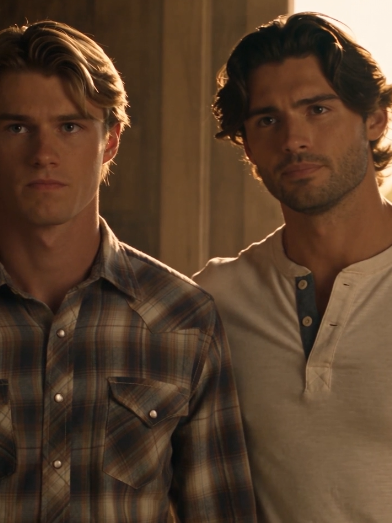
The Rancher Stood in the Barn at Sunset Holding a Velvet Ring Box—Then He Opened It and Found Two Identical Silver Rings.134

**Title: **
The barn was quiet except for the soft nickering of horses and the rustle of hay. The last light of the day filtered through the wooden slats, casting long shadows across the dirt floor. The smell of leather and sweat and old wood hung in the air. It was a place of work. A place of tradition. A place where men had been taught to be men for generations.
Hank stood in the center of the barn, holding a small velvet box. His hands were rough and calloused. His face was weathered and lined. He was sixty-seven years old, a rancher who had spent his entire life on this land. His father had worked this land before him. His grandfather before that.
His son, Luke, walked through the barn door. He was twenty-eight, tall and strong, with his mother’s eyes and his father’s stubborn jaw. He stopped when he saw the box.
“Dad? What’s that?”
Hank opened it. Inside were two silver rings—identical, simple, engraved.
“I found these in your truck.”
Luke’s face went pale. The saddle he had been carrying slipped from his hands and fell into the hay.
“Dad, I can explain—”
At the barn door, another figure appeared. Mateo. He had grown up on this ranch, the son of the foreman. He and Luke had been friends since childhood. They had learned to ride together, to rope together, to work together.
He stood frozen in the doorway.
Hank looked at him. Then he looked at the rings.
“The second one has a name engraved. Whose is it?”
Luke looked at Mateo. His eyes were red. His hands were shaking.
“Mateo’s.”
The barn went silent.
“I’m going to marry him.”
—
**The Confession**
Mateo stepped forward. He stood beside Luke. He looked at Hank.
“Sir, I love your son.”
Hank clenched his jaw. He turned his back. He walked toward the old workbench in the corner of the barn. The silence stretched for what felt like hours.
“If you want us to leave,” Luke said, “we’ll leave tonight.”
Hank did not answer. He opened a small tin box that had been sitting on the workbench for as long as Luke could remember. He had never known what was inside. He had never asked.
Hank reached into the box. He pulled out a ring—a silver ring, tarnished with age.
When he turned back, his eyes were wet.
“This was your grandfather’s ring.”
He held it up. On the inside of the band, barely visible, was a name.
“The name engraved inside is a man’s name.”
—
**The Story**
In 1968, Hank’s father—Luke’s grandfather—had loved a man named Samuel.
They had met in the army. They had served together. They had come home together. They had bought two silver rings and promised to spend their lives together.
But they had never dared to wear them.
The family had forced Hank’s father to marry a woman. The town had whispered. The church had judged. Samuel had left Texas and never returned.
Hank’s father had kept the ring in a tin box for forty years. He had never worn it. He had never spoken of it. But he had kept it. He had kept it through his marriage. Through the birth of his son. Through the death of his wife. Through everything.
Before he died, he had given it to Hank.
“Don’t let our children have to hide like I did.”
—
**The Revelation**
Hank had known about Luke for years.
He had seen the way Luke looked at Mateo. He had seen the way Mateo looked at Luke. He had seen the way they stood close together, the way they laughed at jokes no one else understood, the way they seemed complete when they were together.
He had known.
He had just not known how to say it.
“Your grandfather loved someone he couldn’t be with,” Hank said. “He spent his whole life hiding. He told me not to let that happen to you.”
He held out the ring.
“I’ve been waiting for you to tell me. I didn’t know how to ask.”
Luke stared at his father. Tears were streaming down his face.
“You’re not angry?”
“I was angry. At myself. For not being braver. For not telling you sooner that it was okay.”
—
**The Acceptance**
That night, three men sat on the porch until late.
Hank talked about his father. He talked about Samuel. He talked about the years of silence and the secret that had been kept. He talked about the ring and the promise and the hope that things could be different.
He called Mateo “son.”
Mateo cried.
Luke held his father’s hand.
The moon rose over the ranch. The horses settled in the barn. The night was quiet and warm.
—
**The Wedding**
The following spring, Luke and Mateo were married in the barn.
The same barn where Hank had found the rings. The same barn where Luke had grown up. The same barn where his grandfather had once dreamed of a different life.
The ceremony was small—just family and close friends. The barn was decorated with wildflowers and white lights. The horses watched from their stalls.
On a table near the altar, in a glass frame, was the ring that Hank’s father had kept for forty years. Beside it was a black-and-white photograph of two young men in army uniforms—Hank’s father and Samuel, standing side by side, smiling at a future they never got to have.
Hank walked Luke down the aisle. He kissed his son on the cheek. He shook Mateo’s hand.
“I’m proud of you both,” he said.
—
**The Letter**
A week after the wedding, a letter arrived at the ranch.
It was from Oregon. The return address was unfamiliar. Hank opened it at the kitchen table, with Luke and Mateo beside him.
*Dear Mr. Hank,*
*My name is Daniel. I saw the wedding photos online. I recognized the ring in the photograph—the one in the glass frame.*
*My grandfather was Samuel.*
*He never forgot your father. He never married. He never stopped loving him. He kept a ring too—the matching one. He wore it on a chain around his neck until the day he died.*
*Before he passed, he asked me to find your family. He wanted me to give you something.*
*I have a box of letters. Letters he wrote to your father but never sent. Letters he wrote about his life, his loneliness, his hope that one day things would be different.*
*I would like to bring them to you. I would like to meet you.*
*If you want them.*
*Daniel*
—
**The Question**
What was in Samuel’s letters?
That is a question for another time.