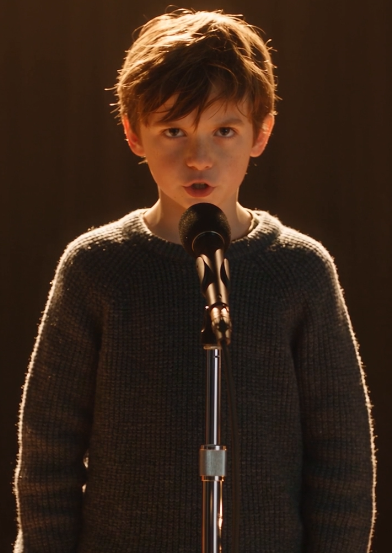
The Boy in the Oversized Thrift-Store Sweater Spelled “Chiaroscurist”—A Word Most Adults Can’t Even Pronounce—Then the Rich Girl Stepped Up and the Judge Smiled, “Lily, Your Word Is ‘Kitten'”.130

**Title: The Boy in the Oversized Thrift-Store Sweater Spelled “Chiaroscurist”—A Word Most Adults Can’t Even Pronounce—Then the Rich Girl Stepped Up and the Judge Smiled, “Lily, Your Word Is ‘Kitten'”**
The auditorium was filled with the nervous energy of children and the proud smiles of parents. Rows of folding chairs had been set up on the stage. A banner hung from the ceiling: *Westbrook County Spelling Bee — Finals*. The judges sat at a long table near the front, their faces carefully neutral. The pronouncer, Mr. Pierce, stood at the podium with a microphone clipped to his lapel.
Sam sat in the third row, his hands clasped tightly in his lap. He was eleven years old, small for his age, with dark hair that needed cutting and glasses that had been mended at the bridge. He was wearing a sweater that was too big for him—a brown cable-knit that he had bought at the thrift store for two dollars. It was the nicest thing he owned.
He had studied for months. He had memorized the dictionary. He had practiced with his sister every night after dinner. He had earned his place here.
And then Mr. Pierce called his name.
“Sam, your word is *chiaroscurist*.”
The auditorium went silent. A few parents whispered to each other. Even the other contestants looked confused.
Sam closed his eyes. He saw the word in his mind—the Italian roots, the silent *h*, the unusual combination of letters. He had seen it in the dictionary. He had written it out ten times. He had made his sister quiz him on it just last night.
“C-h-i-a-r-o-s-c-u-r-i-s-t,” he said. “Chiaroscurist.”
Mr. Pierce nodded. “Correct.”
Sam exhaled. He walked back to his seat. He did not smile. He did not celebrate. He simply sat down and waited.
—
**The Rich Girl**
The next contestant was Lily.
She was twelve years old, with blonde hair and a designer dress and shoes that probably cost more than Sam’s entire wardrobe. She walked to the microphone with the confidence of someone who had never been told no.
Mr. Pierce smiled at her. It was a warm smile—a familiar smile.
“Lily, your word is *kitten*.”
The auditorium stirred. Parents began to whisper. Someone in the back row laughed.
*Kitten?* Sam thought. *That’s a word for five-year-olds.*
Lily spelled it without hesitation. “K-i-t-t-e-n. Kitten.”
Mr. Pierce nodded. “Correct.”
Lily walked back to her seat. She did not look at Sam. She did not look at anyone.
—
**The Break**
The judges called for a fifteen-minute break.
Sam stayed in his seat. He watched as Mr. Pierce stood up and walked toward the back of the stage. He disappeared behind the curtain.
But the microphone on his lapel was still on.
The red light was still glowing.
And the speakers were still broadcasting.
—
**The Conversation**
The entire auditorium heard it.
“Catherine, I did what you asked. I gave Lily easy words.”
A woman’s voice—sharp, impatient—responded. “Good. And the envelope?”
“Same as last year.”
“Make sure she wins. I don’t want a repeat of last year.”
“Don’t worry. I’ve already prepared the list for next year’s state finals. Lily’s name is at the top.”
The auditorium erupted.
Hundreds of people turned to look at the speakers. Hundreds of heads swiveled toward the curtain. The woman—Catherine—was standing behind the stage, her purse open, a thick envelope visible inside. She did not know that everyone could hear her. She did not know that her words were being broadcast to every corner of the room.
And then the purse slipped.
It fell to the floor. The envelope slid out. Money—hundreds of bills—scattered across the stage.
—
**The Confrontation**
Sam stood up.
He walked to the stage. He picked up the microphone that Mr. Pierce had left on the podium. He held it in his hand.
“Last year,” he said, “my sister was in the finals.”
The auditorium went silent.
“She was thirteen years old. She was the best speller in the county. She had studied for months. She had memorized the entire dictionary.”
He paused.
“She lost because of a word that even our English teacher had never heard. She cried the whole way home. She never competed again.”
He looked at Mr. Pierce.
“Last year, she lost to your daughter. By one word.”
—
**The Truth**
Grace had been the best speller in Westbrook County. She had won every competition leading up to the finals. She had been the favorite to win. She had been prepared for anything.
But she had not been prepared for Mr. Pierce.
He had given her an impossible word—a word so obscure that no one in the audience had ever heard it. He had given Catherine’s daughter an easy word—a word that any child could spell.
Grace had lost. Catherine’s daughter had won. The scholarship had gone to the wrong person.
Grace had been devastated. She had stopped competing. She had stopped studying. She had stopped believing that hard work mattered.
But this year, she had found a way to fight back.
Grace was the student in charge of the sound system. She had volunteered for the job. She had learned how the microphones worked. She had learned how to route the audio.
When she saw Mr. Pierce walk toward Catherine during the break, she had quietly pushed the microphone switch to the main speakers.
She had not planned it. She had not known what he would say. But she had suspected. She had known something was wrong.
And now, everyone knew.
—
**The Aftermath**
The organizers cancelled the results on the spot.
A new judge was brought in. The finals were re-held with the same word list for both contestants. Sam won. Lily did not know what her mother had done. She was the first person to stand up and applaud for Sam.
Mr. Pierce was banned from judging forever. Catherine was reported to the state spelling bee association. The scholarship was revoked from her daughter and awarded to Grace—the rightful winner of last year’s competition.
Grace was given a co-champion title. She was invited to compete in the state finals. She accepted.
Sam and Grace went home together that night. They did not have much. They did not have money or connections or a fancy house. But they had each other. And they had the truth.
—
**The Envelope**
But the envelope on the floor contained more than money.
Among the bills was a folded piece of paper. A list. A list of names—the contestants who would be chosen for next year’s state finals. The list had been written before the tryouts had even begun.
Someone had planned everything. Someone had planned the winners and the losers. Someone had planned the future.
Who wrote that list?
That is a question for another time.