The Most Feared Food Critic in America Sent Back Her Dish—Then a 15-Year-Old Dishwasher Stepped Forward and Said, “Let Me Try”.124

**Title: **
The restaurant was called Lumière, and it was the kind of place where reservations were made months in advance, where the wine list was longer than most novels, and where the lighting was always soft and golden, as if the entire room had been dipped in honey. It was the kind of place where careers were made and destroyed, where a single review could fill the tables for years or empty them overnight.
And tonight, the most feared food critic in America was sitting at table seven.
Her name was Vivienne Moreau. She had been writing reviews for forty years. She had closed more restaurants than most health inspectors. She had made chefs cry, made owners beg, made investors flee. She was not cruel for the sake of cruelty—she was precise. She was exacting. She demanded perfection, and she accepted nothing less.
Tonight, she had ordered the chef’s signature dish—a bouillabaisse that had won awards, that had been featured in magazines, that had been praised by critics across the country. It was the dish that had made Laurent Dubois famous. It was the dish that had earned him his stars.
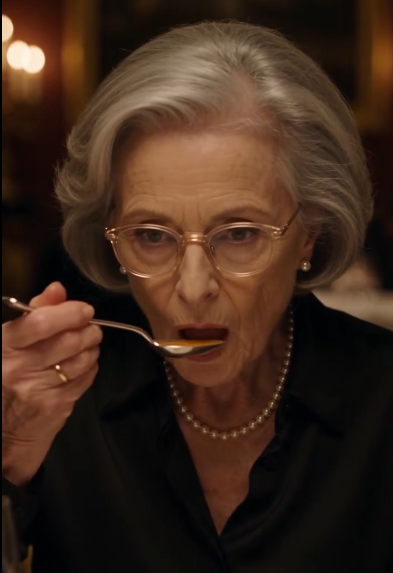
She took one spoonful. She set down the spoon. She pushed the bowl away.
“Send it back,” she said.
—
**The Chef**
Laurent Dubois had been a chef for thirty years. He had trained in Paris, worked in Tokyo, opened restaurants in London and New York. He had earned two Michelin stars. He had been named Chef of the Year three times. He had nothing left to prove.
But when the waiter returned with the untouched bowl of bouillabaisse, he felt his heart stop.
“What do you mean, she sent it back?”
“She said it was not right.”
“Not right? It’s my signature dish. It’s perfect.”
The waiter did not answer. He simply set the bowl on the counter and stepped back.
Laurent picked up a spoon. He tasted the soup. It was perfect. The broth was rich, the seafood was fresh, the seasoning was balanced. It was exactly what it was supposed to be.
He slammed his hand on the table.
“Impossible! That is my signature dish!”
The kitchen went silent. The line cooks froze. The sous chef stepped back.
And then a voice came from the corner.
“Chef? Can I try?”
—
**The Dishwasher**
His name was Nico. He was fifteen years old, small for his age, with dark hair that fell across his forehead and hands that were red from washing dishes. He had been working at Lumière for three months. He had never spoken to the chef. He had never spoken to anyone except the other dishwashers and the servers who brought him the dirty plates.
But he had been watching. He had been listening. He had been learning.
“What did you say?” Laurent demanded.
“I said, can I try? I know a soup she might like.”
Laurent laughed. It was not a kind laugh. It was the laugh of a man who had been insulted by a critic and was now being insulted by a child.
“The dishwasher wants to cook. Go ahead. Embarrass yourself.”
He grabbed the lid of a pot and tossed it at Nico. It clattered to the floor.
Nico did not flinch. He simply walked to the stove. He found a pot. He found ingredients. He worked quietly, carefully, methodically. He did not rush. He did not panic. He simply cooked.
And then he sprinkled a pinch of cinnamon into the golden broth.
—
**The Critic**
The waiter carried the new bowl to table seven. Vivienne looked at it. She looked at the waiter.
“I did not order this.”
“The chef sent it. He said—”
“I don’t care what he said. I did not order this.”
“Please. Just one taste.”
She sighed. She picked up her spoon. She dipped it into the broth. She brought it to her lips.
And then she went still.
The spoon trembled in her hand. Her eyes widened. Her breath caught in her throat.
“Who made this?”
The waiter stepped back. “The dishwasher, ma’am.”
“The dishwasher?”
“Yes, ma’am. A boy. He said it was his mother’s recipe.”
Vivienne set down the spoon. Tears were streaming down her face.
“Cinnamon in the broth. Only my daughter made it this way. Only my Isabelle.”
—
**The Truth**
Laurent had followed the waiter to the dining room. He had watched the critic taste the soup. He had watched her cry.
“Who is Isabelle?” he asked.
Vivienne looked up at him. Her eyes were still wet, but her voice was steady.
“Isabelle is my daughter. She ran away twenty years ago with a young chef. A sous chef. A boy with big dreams and no money.”
She paused.
“Hello, Laurent.”
Laurent’s face went white. He looked at the boy standing behind him. He looked at the cinnamon in the pot. He looked at the critic.
“Isabelle is Nico’s mother.”
“I know.”
“She ran away with me.”
“I know.”
“She never told me she was pregnant.”
“She was too proud. And you were already gone.”
—
**The Story**
Twenty years ago, Isabelle Moreau had fallen in love with Laurent Dubois. He was a sous chef at her mother’s restaurant. He was ambitious. He was talented. He was everything she had ever wanted.
But Vivienne had forbidden the relationship. Laurent was not good enough. Laurent was not from the right family. Laurent was not worthy of her daughter.
So Isabelle and Laurent ran away to New York.
They were happy for three months. They lived in a tiny apartment. They worked in a small restaurant. They talked about opening their own place someday.
And then Laurent received an offer. A job in Paris. A position at a Michelin-starred restaurant. A chance to prove himself.
He accepted without hesitation.
He did not know Isabelle was pregnant. She had not told him. She had been afraid. She had been proud. She had thought he would stay if he knew, and she did not want him to stay out of obligation.
So she let him go.
She raised Nico alone. She worked in small kitchens, cooking small meals, teaching her son the recipes her mother had taught her. Every Sunday, she made the soup with cinnamon. It was her mother’s recipe. It was the only thing she had left of her old life.
When she got sick—when the doctors told her she could no longer work—Nico went to find a job. He washed dishes at the first restaurant that would hire him. He did not know it was Laurent’s restaurant. He did not know Laurent was his father.
—
**The Reunion**
The DNA test confirmed it. Laurent was Nico’s father.
Laurent went to the hospital. He saw Isabelle for the first time in sixteen years. She was thin, pale, tired. But her eyes were the same.
“I’m sorry,” he said. “I’m so sorry.”
She looked at him. She did not speak for a long time.
“You didn’t know,” she said finally. “I never told you.”
“I should have stayed. I should have asked.”
“You had a dream.”
“I had you. I had us. I gave it up.”
She reached out and took his hand.
“You’re here now.”
—
**The New Beginning**
Vivienne paid for Isabelle’s medical bills. She paid for the best doctors, the best treatments, the best care. She had lost her daughter once. She was not going to lose her again.
Nico’s soup was added to the menu. It was called “Isabelle’s Sunday Soup.” It became the most popular dish in the restaurant.
Nico became the youngest sous chef in Lumière’s history. Laurent trained him personally. He taught him everything he knew. He also learned—how to be a father, how to be present, how to be patient.
It was not easy. It was not quick. But it was a start.
—
**The Question**
A year later, Isabelle was recovering. She was sitting in her mother’s garden, watching Nico and Laurent cook together on the outdoor grill. She was smiling.
But then she remembered something.
She turned to her mother.
“Mom? There’s something I need to ask you.”
“What is it?”
“That year Laurent left. He didn’t just decide to go. Someone bought him the plane ticket. Someone paid for everything.”
Vivienne did not answer.
“Who was it, Mom?”
Vivienne looked at her daughter. Her eyes were filled with something—guilt, perhaps, or regret.
“It was me.”
—
**The Question**
Why did Vivienne buy Laurent’s plane ticket?
That is a question for another time.