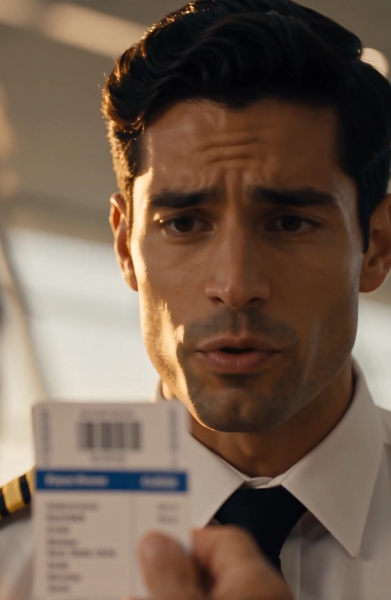
The Airport Agent Knocked the Grandmother’s First-Class Ticket to the Floor—Then the Captain Walked Out and Said, “Grandma?”121

**Title: **
The airport was crowded with holiday travelers. Long lines snaked through security. Announcements crackled over the intercom. People rushed past with rolling suitcases and crying children and cups of overpriced coffee. The gate agent, Ashley, was tired. She had been working since six in the morning. She had dealt with delayed flights, angry passengers, and a broken computer system. She was not in the mood for complications.
The old woman approached the gate slowly, leaning on a wooden cane. She was seventy-eight years old, small and frail, with silver hair pulled back in a bun and a faded blue dress that had been mended at the hem. She was holding a ticket—a first-class ticket—and she was smiling.
“Excuse me,” she said. “Is this the gate for Flight 427?”
Ashley glanced at the ticket. Then she glanced at the woman. Then she glanced at the ticket again.
“You’re in the wrong line,” she said. “Economy boards last. Stand over there.”
The woman blinked. “But I have a first-class ticket.”
Ashley laughed. It was not a kind laugh. “Sure you do.”
She reached for the ticket. The old woman’s fingers fumbled. The ticket slipped. It fluttered to the floor and landed face-up—*First Class, Seat 1A.*
A few passengers nearby giggled. The old woman bent down slowly, her joints creaking, her hands trembling. She picked up the ticket and held it against her chest.
“My grandson is flying this plane,” she said. “He’s the captain.”
Ashley rolled her eyes. “Right. And I’m the queen of England.”
The old woman did not argue. She simply smiled. “You’ll see.”
—
**The Captain**
I was standing at the gate, checking my uniform one last time. It was the first time I had worn the captain’s jacket. The first time I had four stripes on my sleeve. The first time I would be sitting in the left seat instead of the right.
I had worked for this moment for twelve years. I had spent years as a flight instructor, years as a first officer, years of training and testing and proving myself. And now, finally, I was ready.
I walked through the terminal. I passed the security checkpoint. I passed the coffee shops and the duty-free stores and the gates. And then I saw her.
My grandmother.
She was standing near the gate, holding her ticket, smiling at the agent. The agent was laughing at her. The agent was mocking her.
I walked faster.
“Grandma?”
She turned. Her face lit up.
“Leo!”
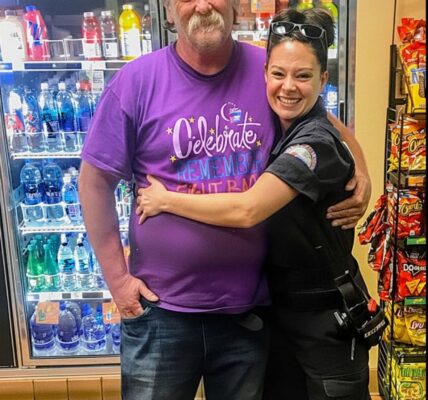
She dropped her cane. She threw her arms around me. She was crying.
“I came to see your first flight as captain,” she said. “I wouldn’t miss it for the world.”
The gate agent’s face went red. She looked at my uniform. She looked at my stripes. She looked at the name tag on my chest.
“Captain?” she whispered.
I looked at her. “Is there a problem?”
“No, sir. I—I didn’t know—”
“You didn’t know what? That my grandmother had a first-class ticket? That she deserved respect? That you shouldn’t laugh at an old woman?”
She did not answer.
—
**The Ticket**
I picked up my grandmother’s cane. I handed it back to her. And then I looked at the ticket in her hand.
“Grandma, I didn’t send you a ticket.”
She looked at me. Her eyes were still wet, but there was something else in them now—something serious.
“Your father bought it.”
I felt my heart stop.
“My father left when I was five years old.”
She pointed toward the window. “He’s on the plane. Seat 2A.”
I stared at her. “What?”
“He’s been watching you, Leo. He’s been watching you for years.”
—
**The Story**
My father’s name was Rafael. He had been a mechanic—not for planes, but for cars. He had worked in a garage, fixing engines, changing tires, doing whatever he could to pay the bills. He had been good with his hands. He had been good with people.
He had also been a good brother.
When I was five years old, my uncle—my father’s younger brother—stole parts from the airline where he worked. Expensive parts. Parts that could be sold for thousands of dollars. He had been caught. He had been arrested.
But my father had taken the blame.
He had told the police he did it. He had told the judge he did it. He had gone to prison for three years. He had protected his brother. He had sacrificed himself.
He had asked my mother not to tell me. He had said he did not want me to grow up with the shadow of a father who was in prison. He had said he would come back when he could. He had said he would make things right.
He never came back.
He was ashamed. He was broken. He had lost three years of his life, and he did not know how to face his son.
But he never stopped watching.
He sent money to my grandmother—every month, every year. He asked her to use it for my flight school tuition. He asked her to tell me it was a gift. He asked her to keep his secret.
She did.
—
**The Reunion**
I flew the plane.
I flew it perfectly. I had never been more focused in my life. I knew he was on board. I knew he was sitting in seat 2A. I knew he was watching me.
When we landed, I walked out of the cockpit. I walked through the first-class cabin. I stopped at row 2.
An old man was sitting there. His hair was grey. His face was lined. His hands were folded in his lap. In his hands was a small wooden model of an airplane.
I recognized it immediately. I had made it when I was five years old. I had given it to him before he left.
“Dad?”
He looked up. His eyes were filled with tears.
“Leo.”
He stood up. His legs were unsteady. He held out the model.
“You made this for me. I’ve kept it every day.”
I took the model. I held it in my hands. And then I hugged him.
We stood there in the aisle, holding each other, while the passengers watched. And then someone started clapping. And then someone else. And then everyone.
—
**The Aftermath**
Ashley, the gate agent, wrote a letter of apology to my grandmother. She was required to retake her customer service training. She did not complain. She knew she had been wrong.
My grandmother flew with me on every important flight after that. She always sat in the front row. She always told the other passengers that her grandson was the captain.
My father moved back to the city. He rented a small apartment near the airport. He came to dinner every Sunday. He came to all my flights. He sat in seat 2A every time.
But one night, when it was just the two of us, he showed me something.
A piece of paper. An old document.
“Your parole,” he said. “From twenty-five years ago.”
I looked at it. It was signed at the bottom by a man named Captain William Hayes.
“The man who signed my parole,” my father said, “was the same man who accepted you into flight school.”
I stared at him.
“Who is he?”
My father looked at me. His eyes were serious.
“He was my cellmate,” he said. “And he was your mother’s brother.”
—
**The Question**
Why did Captain William Hayes help both my father and me?
That is a question for another time.