
**Title: The Real Estate Agent Snatched the Brochure from the Old Man’s Hands and Said, “Sir, This Showing Is Only for Buyers with Sufficient Funds”—Then He Tapped His Cane on the Third Stair and Said, “This One Always Creaks. My Wife Loved That Sound.”**
The lakefront mansion was stunning. Three stories of glass and stone, with a wraparound deck overlooking the water, a private dock, and gardens that had been featured in magazines. It was listed at $4.2 million, and there had already been three offers. Brittany, the real estate agent, was expecting a fourth that afternoon. She was standing in the foyer, checking her phone, when the old man walked in.
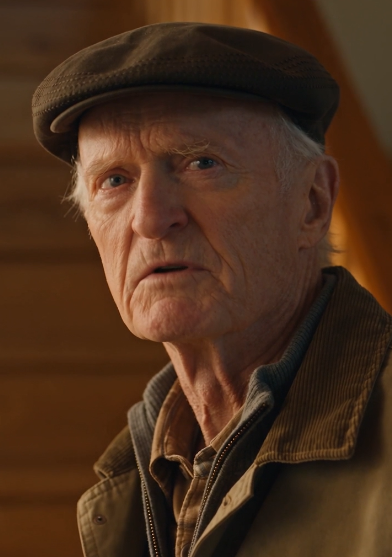
He was not supposed to be there. The showing was by appointment only. He was not on the list. He was wearing a worn brown coat that had been patched at the elbows, and he was leaning on a wooden cane. His shoes were scuffed. His hands were gnarled with age.
He walked slowly through the foyer, his eyes moving over the walls, the windows, the staircase. He stopped in front of the staircase. He reached out and touched the banister.
“Sir,” Brittany said, walking toward him. “This is a private showing. You can’t just walk in.”
The old man did not turn around. “I just want to look at it one more time.”
“I’m going to have to ask you to leave.”
He turned. His eyes were wet.
“Please. Just for a moment.”
Brittany sighed. She pulled a brochure from the stack on the entry table and held it out to him. “Here. Take this. It has photos. You can look at those.”
The old man reached for the brochure. His fingers brushed against hers. And then he spoke.
“I built this house.”
Brittany froze.
“I built it with my own hands. Forty years ago. For my wife.”
He walked to the staircase. He tapped his cane against the third step. It creaked.
“This one always creaks. I never fixed it. My wife loved the sound. She said it reminded her that the house was alive.”
He pointed to the window seat. “There are two letters carved into the wood underneath. G and E. Inside a heart.”
Brittany knelt down. She looked under the window seat. And there they were—two letters, faded but visible, inside a small heart.
She stood up. Her face was pale.
“Who are you?”
—
**The Son**
The front door opened. A man walked in—middle-aged, well-dressed, with a smile that was meant to be confident but faltered when he saw the old man.
“Brittany, have we had any offers?”
And then he saw him.
The keys fell from his hand. They clattered against the marble floor.
“Dad?”
The old man looked at his son. His eyes were not angry. They were tired.
“I built this house with my own hands, Steven. You told me the bank took it.”
Steven’s face went white. “Dad, I can explain—”
“You told me the bank took it because I couldn’t pay the medical bills.”
“Let’s talk about this somewhere else—”
“You put me in a nursing home and told me I had no choice.”
“Dad—”
“You told me I was a burden.”
—
**The Story**
George had built the house for his wife, Eleanor. They had been married for forty-two years. They had raised their son, Steven, in that house. They had celebrated birthdays and anniversaries and Christmases. They had watched the sun set over the lake from the deck. They had listened to the third stair creak every time they walked up it.
When Eleanor died, George was devastated. He stopped eating. He stopped sleeping. He stopped taking care of himself. And then he fell.
He was in the hospital for three months. He had broken his hip. He had broken his spirit.
Steven had come to him with papers. He had said he would take care of everything—the house, the finances, the medical bills. He had said George needed to focus on recovery. He had said signing over power of attorney was the best thing to do.
George had signed.
And then Steven had moved him to a nursing home. He had told George that the bank had repossessed the house. He had told him the medical bills had consumed everything. He had told him he was sorry.
George had believed him.
He had believed him for two years.
Until a nurse at the nursing home had shown him a real estate listing on her phone. A lakefront mansion. A property in his old neighborhood. A house that looked exactly like his.
She had asked if he knew the place.
He had said yes.
He had said it was his home.
—
**The Truth**
Steven was in debt. He had made a bad investment—a business deal that had gone wrong. He owed nearly a million dollars to people who did not forgive debts. He had tried to hide it. He had tried to fix it. But the hole kept getting deeper.
Selling his father’s house was the only way out.
He had convinced himself that George would not mind. He had convinced himself that George was too old to notice. He had convinced himself that it was the right thing to do.
He had not counted on his father showing up at the open house.
He had not counted on the nurse.
He had not counted on the third stair.
—
**The Confrontation**
Steven knelt in front of his father. He was crying. His hands were shaking.
“I’m sorry,” he said. “I’m so sorry.”
George looked down at him. His son. The boy he had raised. The boy he had taught to fish and to drive and to fix things. The boy who had once promised him he would never be alone.
“You lied to me,” George said.
“I know.”
“You put me in a home.”
“I know.”
“You tried to sell my house.”
“I know.”
“You tried to sell my life.”
Steven buried his face in his hands. “I didn’t know what else to do.”
“You could have told me the truth. You could have asked for help.”
“I was ashamed.”
“You were ashamed. But you were not alone. You had me.”
Steven did not answer.
—
**The Aftermath**
George did not press charges. He was not that kind of man. But he did demand that the power of attorney be revoked. He did demand that he be allowed to return home. He did demand that Steven never make a decision for him again.
Steven agreed.
Brittany removed the listing. She apologized to George for treating him like he did not belong. She offered to help Steven find a lawyer to restructure his debts. She offered to help him find a way out that did not involve betraying his father.
Steven agreed.
Every Sunday morning, Steven had to come to the house and help his father fix things. The porch railing. The leaking faucet. The loose floorboard in the hallway.
But not the third stair.
The third stair was never fixed.
—
**The Envelope**
A month after George moved back home, he was cleaning out the bedroom. Steven had left some things behind—papers, old files, things he had not bothered to collect.
George found an envelope at the bottom of a drawer.
It was unsealed. It had his wife’s name on it—Eleanor.
He opened it. Inside was a document. A new will. Signed by Eleanor. Dated one week after her death.
George stared at it. His hands were shaking.
It was a will. It changed everything. It gave the house to George, but it also gave something else—something unexpected—to someone else.
But Eleanor had been dead for two years. She could not have signed a will after her death.
Someone had forged it.
Who?
That is a question for another time.