The Maid Who Served for 30 Years Was Actually the Heiress—And the Will Reading Left the Family Speechless.120

The tea tray slipped from my hands.
I had been pouring tea for the Blackwell family for thirty years. I knew how they liked it—Trent took his with two sugars, Margo with a splash of cream, Mrs. Eleanor with nothing at all. I knew which cups were their favorites, which chairs they preferred, which topics of conversation would make them smile and which would make them frown.
I had learned all of this over three decades of service. I had learned to be invisible. I had learned to be quiet. I had learned to accept the small humiliations that came with being the help.
But I had never learned to expect what happened that afternoon.
Margo Blackwell bumped into me as I was pouring. The tea splashed across the tray, staining the white linen cloth. She did not apologize. She did not even look at me.
“Clumsy as always,” she said. “The help should wait outside.”
—
**The Reading**
The lawyer’s office was large and formal, with leather chairs and mahogany desks and portraits of men who had been dead for a century. The Blackwell family had gathered for the reading of the will. Theodore Blackwell, my employer of thirty years, had passed away two weeks earlier. He had been eighty-seven years old.
I had been his housekeeper. I had cooked his meals, cleaned his home, managed his household. I had been there when his wife died. I had been there when his children stopped visiting. I had been there every day, every week, every year.
I had been there when no one else was.
I was standing near the door, holding the tray, when the lawyer raised his hand.
“Mr. Blackwell requested that Mrs. Morales stay.”
I froze. Margo and Trent turned to look at me. Their faces were confused. Their eyes were cold.
“Stay?” Margo repeated. “Why would Father want the housekeeper to stay?”
The lawyer did not answer. He simply pressed a button on a remote. A screen descended from the ceiling. And there, on the screen, was Theodore Blackwell.
—
**The Message**
He was sitting in his study—the same study I had cleaned every day for thirty years. He was wearing his favorite cardigan, the one with the patches on the elbows. He was smiling.
“If you are watching this,” he said, “then I am gone.”
Trent leaned forward. Margo folded her arms.
“I have left everything—the house, the company, the entire estate—to Ana Morales.”
The room went silent.
Trent stood up. His chair fell backward. “To the maid? He’s lost his mind!”
I stood frozen. My hands were still holding the tray. My heart was pounding.
Theodore leaned closer to the camera.
“Ana was never my housekeeper. Ana is my daughter.”
The teacup slipped from Margo’s hand. It shattered on the floor.
—
**The Truth**
I had known for years.
I had known since I was twenty years old, when my mother died and a man I had never met came to my door. He had told me he was my father. He had told me he had loved my mother. He had told me he had wanted to marry her, but his family had forbidden it.
He had offered me a job—a position as his housekeeper. He had said it was the only way he could be close to me without causing a scandal. He had said he was sorry.
I had accepted.
For thirty years, I had cooked his meals and cleaned his house and managed his affairs. For thirty years, I had eaten breakfast with him in the kitchen every morning. For thirty years, I had called him “Mr. Blackwell” while he called me “Ana.”
For thirty years, he had never once called me his daughter.
But he had paid for my son’s education. He had attended my son’s graduation. He had held my hand when my husband died. He had been there.
He had been my father, even if he could not say the words.
—
**The Confrontation**
“Trent, Margo,” Theodore said from the screen. “Ask your mother why I had to hide her.”
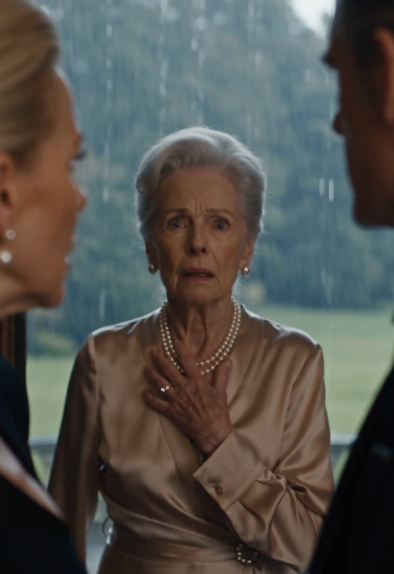
Trent and Margo turned toward the door. Their mother, Eleanor, was standing there. She was eighty-five years old, thin and frail, dressed in black. Her hands were clutching her pearl necklace.
“Mother?” Trent said. “What is he talking about?”
Eleanor did not answer. She simply looked at me. Her eyes were filled with something I had never seen before—guilt, perhaps, or regret.
“Fifty years ago,” Theodore continued, “I fell in love with a girl named Rosa Morales. She sold flowers on the corner of Fifth and Main. She was beautiful. She was kind. She was everything I had ever wanted.”
He paused.
“But my family had other plans. They forced me to marry Eleanor. They told me that if I did not, they would cut me off. They told me that if I did not, the company would fail. They told me that if I did not, Rosa would be ruined.”
Eleanor’s hands tightened on her necklace.
“I married Eleanor. I did what I was told. But I never stopped loving Rosa.”
—
**The Secret**
“When Eleanor found out that Rosa had given birth to a daughter,” Theodore said, “she threatened to leave me. She threatened to take the children. She threatened to withdraw her family’s money from the company. She threatened to make sure Rosa and her child were destroyed.”
I felt tears in my eyes.
“I could not let that happen. I could not let Rosa suffer because of me. So I made a choice. I stayed with Eleanor. I raised my children. I built the company. But I never forgot.”
He looked directly at the camera.
“When Rosa died, I brought Ana into my home. I gave her a job. I gave her a place to live. I gave her everything I could without revealing the truth.”
He paused.
“I have been a coward. I have been a liar. But I have never stopped loving my daughter.”
—
**The Aftermath**
The DNA test confirmed what Theodore had said. Ana was his daughter. She was a Blackwell.
The estate was divided. Theodore had left everything to Ana—the house, the company, the fortune. But Ana did not keep it all.
She divided it. She gave Trent and Margo each a share. She gave them a place in the company. She gave them a chance.
But there was a condition.
They had to work at the Rosa Morales Foundation—a charity Ana had established in her mother’s name—for two years. They had to help people who had been forgotten. They had to understand what it meant to be invisible.
Margo was the first to apologize. She came to Ana’s office—the office that had once been Theodore’s—and she stood in front of the desk.
“I’m sorry,” she said. “I treated you terribly.”
Ana nodded. “You did.”
“I didn’t know.”
“I know.”
“I want to make it right.”
Ana looked at her. She saw something in Margo’s eyes—something she had never seen before. Regret. Remorse. Hope.
“Then start by calling me sister,” Ana said.
Margo’s eyes filled with tears. “Sister.”
—
**The Letter**
A month after the will was read, Ana was going through Theodore’s safe. She found letters, photographs, documents—all the things he had kept hidden for decades.
And then she found a second letter.
It was addressed to her. It was in Theodore’s handwriting.
*Ana,*
*If you are reading this, then I am gone. There is one more thing I need to tell you.*
*Your mother did not die of illness. The doctors said it was pneumonia. But it was not.*
*Read the hospital records from 1994. Ask them what they found in her blood.*
*I have carried this secret for thirty years. I am sorry I could not tell you while I was alive.*
*I am sorry I could not tell you the truth.*
*Your father,*
*Theodore*
—
**The Question**
What happened to Rosa Morales?
That is a question for another time.