The Association President Tore Up the 80-Year-Old Woman’s Application in Front of the Entire Neighborhood—Then the Old Woman Pulled Out a Yellowed Contract and Said, “Perhaps We Should Discuss This Building”.125

**Title: **
The community center was filled with people—families who had lived in the neighborhood for decades, elderly couples who had raised their children on these streets, young parents who had just bought their first homes. They had all come to the monthly association meeting. They had all come to vote on the new budget. They had all come to discuss the future of their community.
But the meeting had taken a different turn.
Patricia Hayes, the association president, stood at the front of the room, holding a piece of paper. She was a tall woman in her fifties, with sharp eyes and a sharper tongue. She had been president for six years. She had made enemies. She had made allies. She had made sure that things were done her way.
The paper she was holding was an application—an application from Dorothy Bell, an 80-year-old woman who had lived in the neighborhood for over fifty years. Dorothy had submitted a request to keep her garden. The garden her husband had planted fifty years ago. The garden that was now being threatened by a new rule—a rule that Patricia had created.
“Rules are rules,” Patricia said. She tore the application in half. The pieces fluttered to the floor. “Fine of $5,000. And the garden will be removed on Friday.”
—
**The Neighbors**
The room went silent.
The neighbors looked at each other. They looked at Dorothy. They looked at the floor.
No one spoke.
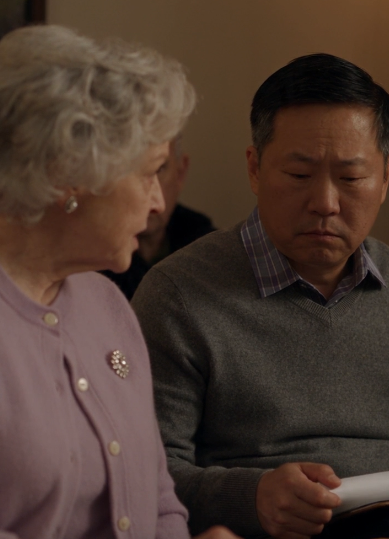
Dorothy was sitting in the back row, her hands folded in her lap. She was small and frail, with silver hair and tired eyes. She was wearing a faded blue dress and a cardigan that had been mended at the elbows. She had not expected this. She had not expected to be humiliated in front of the entire neighborhood.
But she had prepared.
She stood up slowly. She reached into her purse and pulled out an envelope. It was old—yellowed at the edges, worn at the corners. She opened it and pulled out a piece of paper.
“Perhaps we should discuss this building,” she said.
Patricia frowned. “What?”
“The community center. The building we’re standing in.”
“What about it?”
“It’s on my land.”
—
**The Contract**
The room erupted.
People turned to each other. They whispered. They gasped. They asked questions that no one could answer.
Patricia held up her hand. “That’s ridiculous. The community center belongs to the association.”
Dorothy held up the paper. “This is the lease. My husband wrote it fifty years ago. He sold the land to families who wanted to build homes. But he kept this plot—the plot in the center of the neighborhood. He rented it to the association for one dollar per year. The lease expires tomorrow.”
The room went silent again.
Patricia laughed. It was a nervous laugh. “We’ll just renew it.”
Dorothy looked at the treasurer, Mr. Kim. He was sitting near the front, clutching the association’s ledger. He had been quiet all evening. He had been quiet for weeks.
“I will renew it,” Dorothy said, “after you explain where the $200,000 for roof repairs went.”
—
**The Truth**
Mr. Kim stood up.
He was an old man—older than Dorothy, older than most people in the room. He had been the association treasurer for twenty years. He had never missed a meeting. He had never missed a payment. He had never done anything dishonest.
Until now.
Patricia had come to him a month ago. She had told him the roof needed repairs. She had told him she had a contractor who could do the work. She had told him to sign the check.
He had signed it.
But the roof had never been repaired. The contractor had never shown up. The money had disappeared.
“I didn’t know,” Mr. Kim said. “I didn’t know until last week. I didn’t know the contractor was her brother-in-law. I didn’t know the money was going to her.”
He opened the ledger. He showed the room the signatures. He showed the room the payments. He showed the room the truth.
Patricia had been stealing from the association for years. She had been using the money to pay her brother-in-law’s company. She had been using the money to fund her own lifestyle. She had been using the money to do whatever she wanted.
And now, everyone knew.
—
**The Confrontation**
Patricia tried to run.
She stood up. She grabbed her purse. She walked toward the door.
But the door was blocked. Two police officers were standing there. They had been called by Mr. Kim the night before. They had been waiting for this moment.
Patricia was arrested. She was charged with fraud, embezzlement, and abuse of power. She was removed from her position. She was banned from the community center.
The neighborhood watched as she was led away.
And then they turned to Dorothy.
—
**The Renewal**
Dorothy renewed the lease. But she added a condition.
“The front yard of the community center must be filled with roses,” she said. “My husband planted them. My husband loved them. I want them to stay.”
The neighbors agreed.
They planted fifty rose bushes—one for each year of Harold Bell’s life. They planted them in the front yard. They planted them along the fence. They planted them everywhere.
And every year, on the anniversary of Harold’s death, they held a garden party. They celebrated. They remembered. They honored.
—
**The Letter**
A week after Patricia was arrested, Mr. Kim was cleaning out her office.
He found a letter. It was addressed to a real estate company. It was an offer to buy the entire neighborhood.
The signature at the bottom was Dorothy’s son.
—
**The Question**
What did Dorothy’s son know?
That is a question for another time.